Designate: Prioritize Your Tasks, page 183.
- Just because something is important doesn’t mean that it is important right now.
- The trick is to systematically decide what deserves your attention now, what deserves your attention later, and what doesn’t deserve your attention at all.
Design Your Week: The Weekly Preview
- Leaders and professionals rarely have big initiatives that are accomplished in a single week.
- Rather, we face complex projects that take several weeks, even months, to complete.
- Despite our best efforts to stay focused over the long haul, it’s easy to let the beast get away.
- The good news is that you can design your week to keep visibility on your major tasks and review your progress as you go.
- The trick is to break down your major goals and initiatives into manageable next steps. Then you can map those steps onto your week.
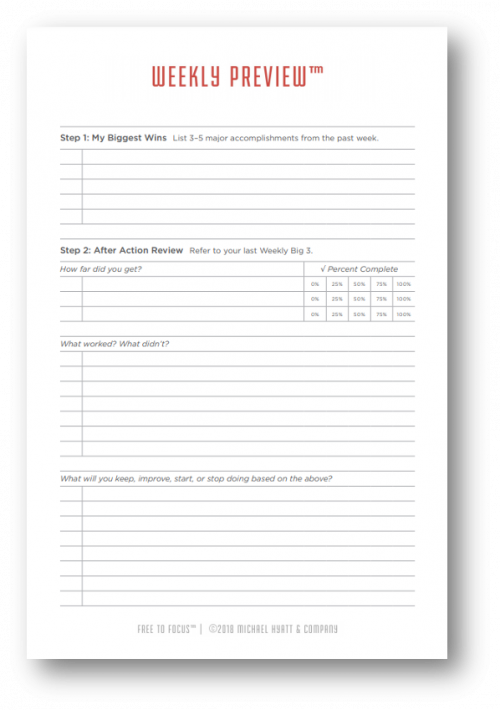
- The Weekly Preview consists of six steps that will enable you to keep track of all the tasks whizzing overhead and establish a sense of control over your time.
- The best times I’ve found are Friday afternoon, Sunday evening, or Monday morning.
- Be sure to schedule it as a recurring appointment on your calendar, starting with thirty minutes.
- The process is an opportunity to get ahead of the chaos.
The Weekly Preview
Step 1: List Your Biggest Wins
- Take a moment to reflect on your biggest wins from the past week. High achievers too often focus on their shortcomings.
- Focusing on wins instead generates feelings of gratitude, excitement, and personal efficacy and sets you up to tackle big things in the coming week.
Step 2: Review the Prior Week
- Perform a mini After-Action Review.
- Carefully go through your prior week to recall any lessons you learned and adjustments you should make to see improvement in the near future. Ask yourself three questions:
- How far did you get on your major tasks from the prior week (aka your Weekly Big 3)?
- What worked and what didn’t?
- Were there interruptions or distractions you hadn’t counted on?
- What were they?
- Who caused them?
- Could you have avoided them?
- What about your plan? Was it good? Did you budget your time well?
- What will you keep, improve, start, or stop doing based on what you just identified?
- The goal here is to note what strategies or tactics were effective and identify anything wrong so that you can upgrade your performance the next week.
- People who can learn from their experiences to make positive changes in their behavior will advance quickly.
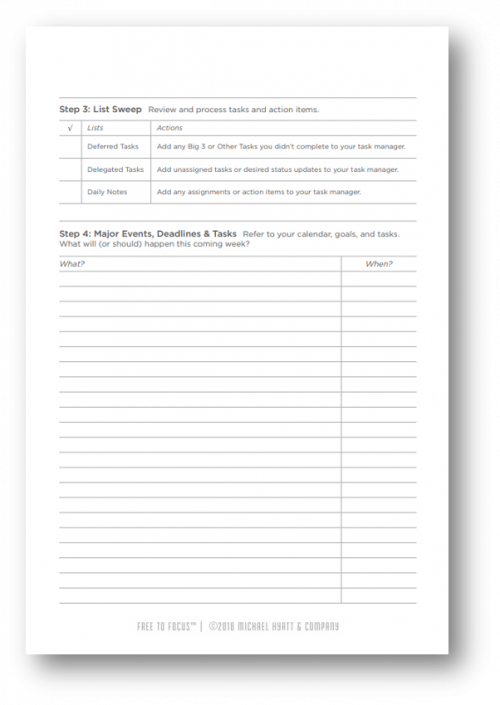
Step 3: Review Your Lists and Notes
- Review your task lists and daily notes so that they don’t get out of hand.
- I advise keeping your task lists in one place.
- Make sure to review the tasks you’ve delegated to others.
- Use your review time to take one of the four following actions:
- Eliminate tasks that are no longer relevant.
- Schedule tasks on your calendar that you will tackle later.
- Prioritize tasks for the week, what I call your Weekly Big 3.
- Defer tasks, keeping some on the back burner and considering them again during your next review.
Step 4: Check Goals, Projects, Events, Meetings, and Deadlines
- Review any goals you are pursuing and reconnect with your key motivation.
- Use this time to review key projects and deliverables.
- Check your calendar for the coming week (or the next several). Ask:
- Do I have any conflicts?
- Do I need to cancel or reschedule anything?
- Do I need to prepare for anything?
- Can I delegate anything?
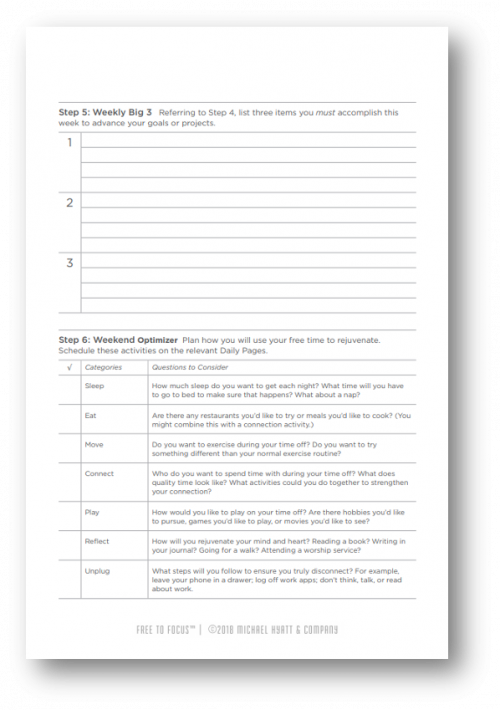
Step 5: Designate Your Weekly Big 3
- It’s time to get proactive and establish your Weekly Big 3.
- Your Weekly Big 3 are the three most important things you need to accomplish in the coming week to keep making progress toward your major goals and projects.
- One helpful filter is the time-tested Eisenhower Priority Matrix popularized by Stephen Covey.
- A simple grid divided into four quadrants in which the horizontal axis corresponds to urgency, the vertical to importance.
- Quadrant 1 includes tasks that are both important and urgent. These should get the first claim to your time.
- Quadrant 2 includes tasks that are important but not urgent. These tasks are often neglected.
- Quadrant 3 includes tasks that are time sensitive and important to others, but not necessarily to you.
- This is where many of us run around each week.
- If you aren’t careful, you’ll allow other people’s priorities to supersede your own.
- If you say yes, you are putting Quadrant 1 and/or 2 items at risk.
- Quadrant 4 items are neither important nor urgent to you. These tasks should never make it to your calendar or task lists.
- A simple grid divided into four quadrants in which the horizontal axis corresponds to urgency, the vertical to importance.
- Question. Why do Quadrant 4 items keep making it to your calendar and task lists?
- Confusion. We simply don’t stop to evaluate the activity or task.
- Guilt. We feel like we should do it, even if we know it’s not our responsibility.
- Fear of missing out. We’re scared of saying no.
- If you want to be free to focus, you need to set a goal of spending 95 percent of your time on Quadrant 1 and Quadrant 2 activities.
Step 6: Plan Your Rejuvenation
- Remember the seven practices of rejuvenation (Chapter 3): sleep, eat, move, connect, play, reflect, unplug.
- Take time here to schedule them into your nights and weekends.
Design Your Day: Your Daily Big 3
- Great days don’t just happen; they are caused.
- I spent years going to the office each day with no real plan in place, simply reacting to whatever happened or filling my time with whatever meeting request or interruption popped up.
- If that’s how you start each day, you are doomed to fail
- Your plan can’t be to allow everyone else to steer your day or you’ll never get anything done that matters to you.
- Most of our workdays are filled with two types of activities:
- Meetings
- Meetings represent nondiscretionary time.
- You can cancel or excuse yourself, of course, but dropping out of meetings at the last minute will cost you relationship capital and put your reputation at risk.
- That’s why it’s critical to cover these in your Weekly Preview.
- Tasks
- I always shoot for three, and only three, key tasks each day. I call these my Daily Big 3.
- If you want to stop chronic overwork, make a change: prioritize three and only three tasks.
- How do you choose your Daily Big 3?
- To start with, refer to your Weekly Big 3. These are the top three outcomes you must achieve for the week.
- These should first be tasks in your Desire Zone and other tasks that are in Quadrants 1 and 2 of the Priority Matrix. Try not to let Quadrant 3 tasks sneak in.
- Listing only three tasks for an entire workday may seem like a cop-out, but it requires more discipline and effort than you realize.
- It takes much more effort to look at the twelve things you could do and zero in on the three that really matter.
Fix the Bounds on Your Time
- “It is not that we have a short time to live, but that we waste a lot of it. Life is long if you know how to use it.” -Seneca
- “Men do not let anyone seize their estates, but they allow others to encroach on their lives – why, they themselves invite in those who take over their lives.” – Seneca
- The difficulty is that time is amorphous, and the future doesn’t have fixed bounds.
- The solution is to designate the what and when of our schedules, starting with the week and then the day.
- The Weekly Preview, Weekly Big 3, and Daily Big 3 ensure we not only keep visibility on all the potential tasks we have, but they also set hard boundaries around our time.
- This is a step toward defending your time against interruptions.
Exercise: Design Your Week and Day
- Using the guidelines in this chapter, take the time right now for your first Weekly Preview, including your Weekly Big 3.
- You can download a copy at FreeToFocus.com/tools.
- Once you’re done, set a weekly recurring calendar appointment with yourself to conduct your Weekly Preview every week going forward.
- Next, use your Weekly Big 3 and build your Daily Big 3. Identify the top 3 tasks you must accomplish today, and make sure you secure time to do them on your schedule.