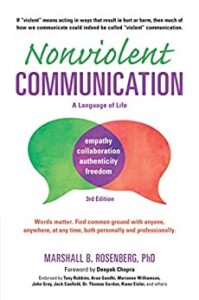
Chapter 3 – Observing Without Evaluating, page 25.
- The first component of NVC entails the separation of observation from evaluation.
- We need to clearly observe what we are seeing, hearing, or touching that is affecting our sense of well-being, without mixing in any evaluation.
- When we combine observation with evaluation, we decrease the likelihood that others will hear our intended message.
- Instead, they are apt to hear criticism and thus resist what we are saying.
- NVC does not mandate that we remain completely objective and refrain from evaluating. It only requires that we maintain a separation between our observations and our evaluations.
- NVC is a process language that discourages static generalizations. We can create many problems for ourselves by using static language to express or capture an ever-changing reality.
The Highest Form of Human Intelligence
- The Indian philosopher J. Krishnamurti once remarked that observing without evaluating is the highest form of human intelligence.
- For most of us, it is difficult to make observations, especially of people and their behavior, that are free from judgment, criticism, or other forms of analysis.
- Sometimes is useful to practice by creating a list identifying specific behaviors, and reviewing the list, making sure it is free of evaluations.
- The words always, never, ever, whenever, frequently, and seldom can contribute to confusing observation with evaluation. When these words are used as exaggerations, they often provoke defensiveness rather than compassion.
Chapter Summary
- The first component of NVC entails the separation of observation from evaluation.
- When we combine observation with evaluation, others are apt to hear criticism and resist what we are saying.
- NVC is a process language that discourages static generalizations.
- Instead, observations are to be made specific to time and context, for example, “Hank Smith has not scored a goal in twenty games,” rather than “Hank Smith is a poor soccer player.”