Formulate: Decide What You Want, page 25.
- We are overwhelmed with emails, texts, phone calls, reports, presentations, meetings, or deadlines – an endless conveyor belt full of new things to do, fix, or think about.
- Therefore, we shove the extra tasks into our nights and fill our weekends with projects that we can’t finish during the workweek.
- It all piles up on the assembly line in our minds, claiming our emotional and physical energy.
- That’s what drives us to explore productivity tips and hacks – to find ways to shave a few minutes off each of the million tasks demanding our attention.
- This is the wrong approach because it does not get to the underlying problem. To find the root issue, let’s finally stop and ask:
- What do we want from our productivity?
- What’s the purpose?
- What are the objectives?
- What do we truly want?
- This chapter will help you formulate your own vision for productivity.
- To get to the heart of the problem, we’ll explore three objectives.
Objective 1: Efficiency
- There is an assumption that working faster is inherently better.
- In reality, however, people try to work faster just so they can cram even more things into their already-packed day.
- Most of us aren’t factory workers; we’re knowledge workers who are hired for our mental output rather than our physical labor.
- The goal of manufacturing is to find ways to work faster. When you apply that to the knowledge economy, however, the work never seems to end. There’s always a new idea to consider or a problem to solve. When we do a good job and complete our work, we’re rewarded with – you guessed it – more work.
- The important question is not, “Can I do this job faster, easier, or cheaper?” It’s, “Should I be doing this job at all?”
- New technology solutions may enable us to work faster, but that efficiency brings with it the temptation and expectation to work more.
Objective 2: Success
- If efficiency isn’t the best goal for our productivity efforts, what about increasing our success?
- It seems reasonable to assume that improved productivity would lead to greater success, right?
- The problem is, most of us have never stopped to define what success means.
- With no clear destination, how will we ever know when we’ve arrived?
- If our goal in increasing productivity is to achieve some vague notion of “success,” we aren’t doing it right.
- Success is a powerful motivator – but only if you understand what success truly means to you.
Objective 3: Freedom
- If productivity isn’t fundamentally about improving efficiency and increasing success, then what is the goal? Why should we even bother?
- That brings us to the real objective, and Free to Focus’s underlying foundation: Productivity should free you to pursue what’s most important to you.
- The goal, the true objective of productivity, should be freedom. I define freedom in four ways:
- Freedom to Focus
- If you want to master your schedule, increase your efficiency and output, and create more margin in your life for the things you care about, you’ve got to learn how to focus.
- Focus is the ability to zero in and do the deep work that creates a significant impact. Focus produces work that moves the needle in a big way, solving real issues.
- Exercise: Think back over the last couple of weeks. How much of your time were you free to focus – truly concentrate – on your work? This is time in which you were able to sit down and attack one task with absolute attention: no distractions, no calls or texts or emails.
- This entire system is designed to bring you the time that you’ve been missing.
- Freedom to Be Present
- How many date nights have you spent thinking about, talking about, or worrying about work?
- How often do you check your work email or messages when you’re out with your family or friends?
- I’m not interested in efficiency which only gives me more time to work longer hours or success that drives me to work when I should be playing.
- I’m after productivity, not efficiency, which means ensuring a significant margin that enables me to be fully present wherever I am.
- Freedom to Be Spontaneous
- So many of us have our lives meticulously planned out to the last minute, and we don’t tolerate any interruptions or deviations. That doesn’t sound like an enjoyable way to go through life.
- Spontaneity only happens when we create margin in our life, and that is the byproduct of real productivity.
- When you know that you have the most important tasks covered and prevent yourself from taking on more than you can comfortably handle, you’ll discover the freedom to be spontaneous.
- Freedom to Do Nothing
- Our “always on” culture undermines our productivity.
- Americans usually feel guilty doing nothing.
- Our brains aren’t designed to run nonstop.
- Most of your breakthrough ideas in your business or personal life come when you’re relaxed enough to let your mind wander.
- Creativity depends on times of disengagement. The implication of this means that doing nothing from time to time is a competitive advantage.
Getting the Right Things Done
- The first action on the path to becoming freer to focus is clarifying your objective(s).
- Productivity is not about getting more things done; it’s about getting the right things done.
- That’s what this book is all about – to help you achieve more by doing less.
- We want to cut away all the tasks that currently eat up your time that you are not passionate about, that are not important to you, and that, frankly, you’re not good at.
- Amazing things happen when you start focusing primarily on what you do best and eliminate or delegate the rest.
- We should design our lives first, and then tailor our work to meet our lifestyle objectives.
What’s Your Vision?
- Why start by stopping to discuss our productivity vision?
- Because jumping to tips, hacks, and apps won’t address the most basic issue.
- We think we can solve our problems by moving to a new app or device, but we’re simply dragging our core productivity problems along with us.
- Doing something different, something better, requires rethinking productivity.
- My most productive coaching clients pursue the third objective: Freedom.
- They have a specific vision for what that looks like in their lives.
- They start with a picture of what they want their lives to look like before they try to fit their jobs into it.
- The endgame is different for everyone, but I at least hope that you’re starting to formulate a vision for what fewer, more productive work hours could make possible.
- Once you complete the following Productivity Vision exercise, you’ll be ready for the next chapter.
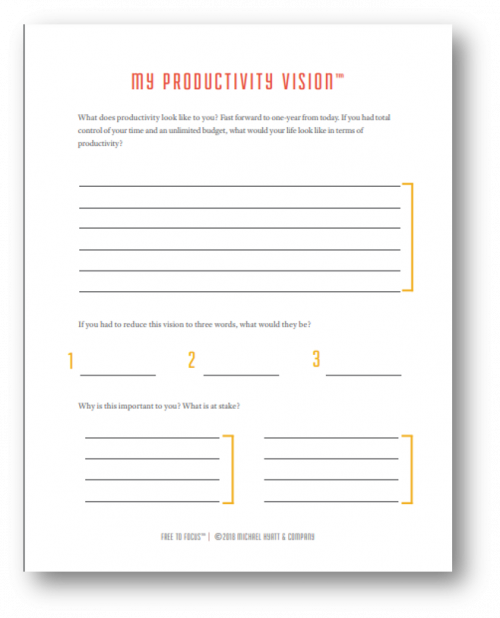
Exercise: Create Your Productivity Vision
- Formulating a new vision for your life is going to require some serious thinking on your part.
- You need to be able to picture it in your head and get crystal clear on what you want your life to look like and why it matters to you.
- To get started, complete the Productivity Vision at FreeToFocus.com/tools.
- Start by defining what your productivity ideal looks like.
- Then, break it down into powerful, memorable words.
- Finally, clarify the stakes by outlining exactly what you stand to gain if you achieve that vision and what you will lose if you don’t.