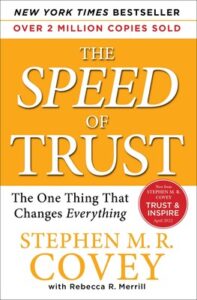
The Second Wave – Relationship Trust, page 125.
“You can’t talk yourself out of a problem you’ve behaved yourself into.” – Stephen R. Covey
“No, but you can behave yourself out of a problem you’ve behaved yourself into…and often faster than you think.” – Stephen M.R. Covey
- The Second Wave – Relationship Trust- is all about behavior… consistent behavior.
- It’s about learning how to interact with others in ways that increase trust and how to avoid interacting in ways that destroy it.
- More specifically, it’s about the 13 Behaviors that are common to high-trust leaders and people throughout the world. These behaviors are powerful because:
- They are based on principles that govern trusting relationships.
- They grow out of the 4 Cores.
- They are actionable.
- They are universal.
Behavior Matters
- The truth is that in every relationship what you do has a far greater impact than anything you say.
- You can say you want to engage in a win-win negotiation, that your company puts the customer first, that people are your most important asset, that you will comply with the rules, that you won’t engage in unethical practices, that you will keep commitments, that you will deliver results…
- You can say all of these things, but unless you do them, your words will not build trust; in fact, they will destroy it.
- Good words have their place. They signal behavior. They declare intent. They can create enormous hope. When those words are followed by validating behavior, they increase trust, sometimes dramatically.
- On the other hand, when the behavior doesn’t follow or doesn’t match the verbal message, words turn into withdrawals
You Can Change Behavior
- Some people say you can’t change behavior. But there is clear evidence to indicate that people can and do change behavior – sometimes dramatically – and that doing so often produces extraordinary results.
- The difference between those who change their behavior and those who don’t is a compelling sense of purpose.
- When your purpose is to accomplish results in a way that builds trust, suddenly the behaviors that build trust are no longer just nice “to-do’s”; they become powerful tools that enable you to enjoy rich, satisfying relationships, greater collaboration, and shared accomplishments.
- If you’re not a caring person now – but you desire to be a caring person – then go out and behave in caring ways. Just do what caring people do. It may take time, but as you do these things, you can behave yourself into the kind of person you want to be.
Building Trust Accounts
- As you work on behaving in ways that build trust, one helpful way to visualize and quantify your efforts is by thinking in terms of “Trust Accounts.“
- By behaving in ways that build trust, you make deposits. By behaving in ways that destroy trust, you make withdrawals.
- The” balance” in the account reflects the amount of trust in the relationship at any given time.
- One of the greatest benefits of the Trust Account metaphor is that it gives you language to talk about trust.
- It’s also valuable because it helps you become aware of several important realities:
- Each Trust Account is unique.
- All deposits and withdrawals are not created equal.
- What constitutes a “deposit” to one person may not to another.
- Withdrawals are typically larger than deposits.
- Sometimes the fastest way to build trust is to stop making withdrawals.
- Recognize that each relationship has two trust accounts.
Things to Keep in Mind
- As we move into the 13 Behaviors, I’d like to call your attention to a few ideas that will help you with understanding and implementation:
- All 13 Behaviors require a combination of character and competence.
- The first five flow initially from character.
- The second five flow from competence.
- The final three flow from an almost equal mix of character and competence.
- Generally, the quickest way to decrease trust is to violate a behavior of character.
- Generally, the quickest way to increase trust is to demonstrate a behavior of competence.
- It’s possible to take any one of these behaviors to the extreme. And any strength pushed to the extreme becomes a weakness.
- These 13 Behaviors work together to create balance. For example, “Talk Straight” must be balanced by “Demonstrate Respect.”
- Along with each behavior, I will note the principles upon which it is based. I will also give the opposite and the counterfeit for each behavior. It’s these opposites and counterfeits (often unrecognized) that create the biggest withdrawals.
- As you think about behaving in ways that build trust, keep in mind that every interaction with a person is a “moment of trust.” The way you behave in that moment will either build or diminish the trust within the relationship.