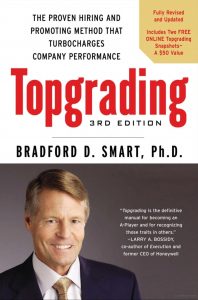
Hiring Step #12: Annually Measure Your Topgrading Success, page 175.
- In Step #12 we close the loop on Topgrading – because we’re sort of doing what we did in Step #1 – we’re measuring hiring success and costs of mis-hires.
- In Step #1 we measured pre-Topgrading results, a baseline, and the poor results motivated managers to Topgrade.
- In Step #12 we measure success Topgrading, and we do it annually.
What is the Problem That This Step Helps Solve?
- Without measurements there can’t be real accountability for yhe quality of hires.
- Without accountability, even the best of best practices wither and die on the vine.
- Step #12 is systematically measuring percent high performers hired and costs of mis-hires (and mis-promotions), pre-Topgrading and since Topgrading.
- Companies use a lot of different measurements, here are some examples:
A Player/A Potentials in Management
| Year 1 | Year 2 | Year 3 | Year 4 | |
| Number (%) A and A Potentials in Senior Management (N=10) | 5 (50%) | 8 (80%) | 10 (100%) | 10 (100%) |
| Number (%) A and A Potentials in Middle Management (N=60) | 15 (25%) | 30 (50%) | 40 (66%) | 55 (92%) |
| Number (%) A and A Potentials in Lower Management (N=200) | 50 (25%) | 80 (40%) | 120 (60%) | 170 (85%) |
Hiring Success When Topgrading is Used, and Not Used
| Topgrading Used | Not Used | |
| Number (%) A or A Potentials Hired | 20 (91%) | 2 (17%) |
| Less than A or A Potentials Hired | 2 (9%) | 10 (83%) |
| Total | 22 | 12 |
Start Step #12 A Year After Topgrading is Launched
- Why? Because it usually takes a year to determine if a manager hired or promoted has turned out to be an A Player.
- One year after the person is hired, the hiring manager, Human Resources, and two others who worked closely with the person meet for an hour.
- The new hire’s Job Scorecard is reviewed and the four decide how the person performed in relation to the stated accountabilities.
- If any 360-degree surveys were done, the results are reviewed.
- A conclusion is reached and the new hire is told, “We consider you an A Player”… or not, and if it is “not,” the person is put on a performance-improvement plan.
Review Your Referral Program performance (At least) Annually
- If only 5% of your hires come from referrals from your people, you will probably launch a program to increase the referrals.
- By tracking the measurements annually, you and your team will know whether your referral program is working or not.