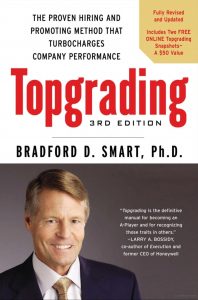
Chapter 1 – Topgrading Basics, page 9.
- Topgrading Myth #1: Topgrading is only for big companies. Not so! Topgrading is arguably more important to small and medium-sized companies in which just a couple of mis-hires could cause a business to fail.
- Our experience and research shows that about 25% of managers hired or promoted turn out to be high-performers, A Players, in every type of company.
- Topgraders achieve 75%, 90%, and even greater success picking high performers – That’s why every company should Topgrade.
- Should companies Topgrade during economic downturns? The Great Recession forced companies to figure out how they can be more successful with fewer people. The CEOs of many case studies in this book report that their companies perform better with fewer people, but those fewer people are A Players.
- The primary reason companies and managers don’t achieve A teams, don’t perform well, and sometimes fail is that they don’t have enough high-performers… and the main reason is that they fail to use accurate methods to assess candidates for hire or promotion.
- Why is it smart for managers to keep some “marginal but adequate” performers? It would be too risky for you to replace low performers if there is a 75% chance your replacements will not be better, and there is a 25% chance your replacements will be worse performers.
- This changes though when you’re a Topgrader. When 75% to 90% of the people you hire and promote turn out to be high performers, it’s smart and rational to replace not only low performers but also marginal performers.
Topgrading Lite
- Use the “TORC” Technique:
- The Threat of Reference Check (TORC) convinces candidates to reveal the whole truth.
- Simply tell candidates, at every step in the hiring process, that they will have to arrange personal reference calls with former bosses and others just before a job offer.
- Use the Topgrading Career History Form, which produces the Topgrading Snapshot.
- The Topgrading Career History Form becomes your application form.
- Asks for the usual application form information plus a lot more.
- It’s a long form that candidates complete online, and when they click submit you will receive it, but you will also receive the Topgrading Snapshot, a multicolor picture of the most revealing aspects of a person’s career
- The Topgrading Snapshot shows you at a glance crucial information, such as dates and job titles, the candidate’s full compensation history, accurate boss ratings, and true reasons for leaving the employer.
- The Snapshot enables you to screen candidates in, and out, in seconds.
- Use the Starter Topgrading Interview Guide:
- The Topgrading Interview is the most powerful hiring tool.
- Use the guide to ask the candidate, who is now motivated to tell the truth, to describe every job in chronological order and specifically to describe every success, failure, key decision, and key relationship, including guesses as to how all bosses will rate them.
- Use two interviewers
- When two trained interviewers are used, managers like you achieve results almost as well as the results Topgrading professionals achieve.
- Ask candidates to arrange personal reference calls with their former bosses and others you choose.
- No telephone tag.
- A Players get their former bosses to talk.
- You and your tandem partner each call half of those references. Then the two of you share notes, and decide whether or not to extend a job offer.
Two More Myths About Topgrading
- Topgrading Myth #2: Topgrading is Getting Rid of C Players
- Please do not interpret what you read to equate Topgrading with firing underperformers.
- If you want to roll out Topgrading, the best way to be sure your organization will fight you every step of the way is to suggest that Topgrading means firing a bunch of people.
- Instead, emphasize the feel-good practices for hiring the best, promoting the best, and coaching to help everyone develop.
- Your performance-management system should deal with poor performers, who should fire themselves for failing to achieve the accountabilities they committed to.
- Topgrading Myth #3: Topgrading is “Rank and Yank”
- Forced distributions can be unfair and they are cousins to “rank and yank,” forced ranking systems with automatic firing (“yanking”) of those ranked at the bottom.
- Jack Welch, former General Electric CEO and a major client of Topgrading, doesn’t advocate for firing people in the bottom 10% if they are A players.
- A Players at the bottom, who met their performance goals and competency goals, should be celebrated and certainly not fired.
- A company firing the bottom 10% every year would have a horribly political culture.
- Forced Distribution:
- You don’t want your top performers shoved into a group with a lower designation than what they are – it insults them.
- Suppose your company has 100 A Players and you have a forced distribution of Top 20%, Middle 70%, and Bottom 10%, it’s okay if you place all 100 As in that bell curve, as long as you either don’t have labels for the categories, or you have accurate labels such as “Top A Player,” “Middle A Player,” “Bottom A Player.”
- Use a forced ranking system annually to help measure talent, but do not require the removal of any high performer JUST because they are ranked close to the bottom.
Topgrading Can be Led by the CEO, Human Resources, or Any Talent-Oriented Manager
- It’s highly unlikely a company will embrace Topgrading launched by HR and achieve 75%+ high performers if the CEO is a softy, unwilling to reinforce the Topgrading disciplines, and overly willing to let managers hire and retain top performers.
- Some companies are seeing success with HR quietly introducing the Topgrading Snapshot to improve hiring at all levels. The Topgrading Snapshot tool threatens no one, is extremely easy to use, saves a huge amount of screening time, and instantly produces significantly better candidates for interviews.