Team Health Assessment, page 191.
- Measures a team’s susceptibility to the five dysfunctions.
- Have all members of your team complete the diagnostic and review the results, discussing discrepancies in the responses and identifying any clear implications for the team.
Instructions
- Use the scale below to indicate how each statement applies to your team.
- It is important to evaluate the statements honestly in without overthinking your answers.
3 = Usually
2 = Sometimes
1= Rarely
- Each question will be categorized based on which dysfunction it addresses.
Questions:
- Team members are passionate and unguarded in their discussion of issues. (Conflict)
- Team members call out one another’s deficiencies or unproductive behaviors. (Accountability)
- Team members know what their peers are working on and how they contribute to the collective good of the team. (Commitment)
- Team members quickly and genuinely apologize to one another when they say or do something inappropriate or possibly damaging to the team. (Trust)
- Team members willingly make sacrifices (such as budget, turf, headcount) in their departments or areas of expertise for the good of the team. (Results)
- Team members openly admit their weaknesses and mistakes. (Trust)
- Team meetings are compelling and not boring. (Conflict)
- Team members leave meetings confident that their peers are completely committed to the decisions that were agreed on, even if there was initial disagreement. (Commitment)
- Morale is significantly affected by the failure to achieve team goals. (Results)
- During team meetings, the most important – and difficult – issues are put on the table to be resolved. (Conflict)
- Team members are deeply concerned about the prospect of letting down their peers. (Accountability)
- Team members know about one another’s personal lives and are comfortable discussing them. (Trust)
- Team members end discussions with clear and specific resolutions and calls to action. (Commitment)
- Team members challenge one another about their plans and approaches. (Accountability)
- Team members are slow to seek credit for their own contributions, but quick to point out those of others. (Results)
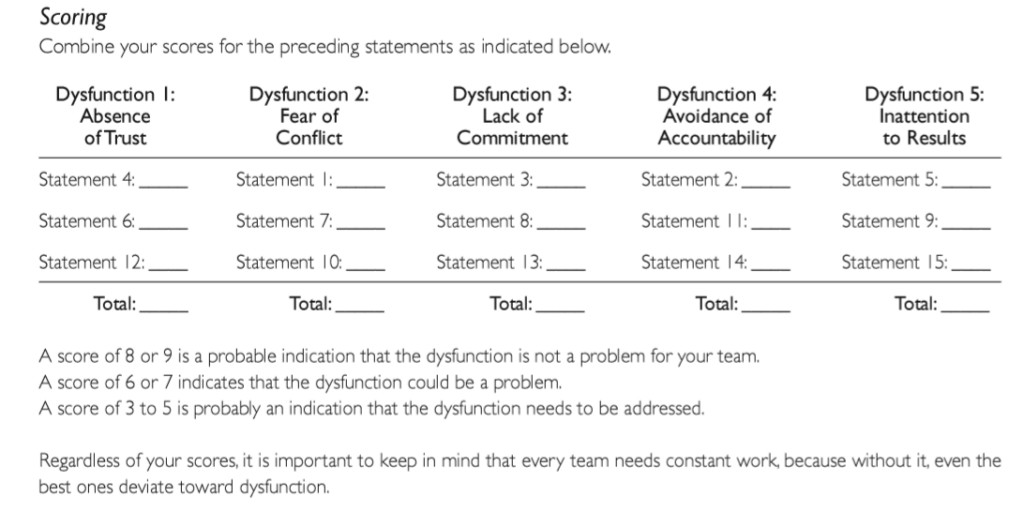
Scoring (by category)
- A score of 8 or 9 is a probably indication that the dysfunction is not a problem for your team
- A score of 6 or 7 indicates that the dysfunction could be a problem
- A score of 3 or 5 is probably an indicator that the dysfunction needs to be addressed